
Brian Phang: From Process Engineering to Digital Innovation
How did a process engineer grow into an Operational Excellence leader?
From process engineering to digital innovation, Brian’s Sanofi journey reflects a career shaped by curiosity, continuous learning, and transformation. Now Head of Site Operational Excellence and Smart Factory in Singapore, he shares how six different roles – and an open mindset – have helped him grow with the company while driving forward its manufacturing evolution.
When I tell people I’ve spent over 17 years at the same company, they often look puzzled. But the truth is, I’ve never really stayed in the same job.
My journey with Sanofi began in 2008. What initially drew me here was rather simple: I could work at one of the world’s top pharmaceutical companies, producing medicines that genuinely transform patients' lives. That purposeful mission still drives everything I do today.
How one company became six careers
When I started as a process engineer, I felt production was where I first truly found purpose in my work. Five years later, I was ready for something different. That’s when I moved into what we then called "Lean" as a lean engineer. Lean was about simplifying processes, cutting waste, and driving continuous improvement. That role sparked my curiosity to step back from daily routines and explore how we could work smarter.
After two years, I transitioned to a team leader role in supply chain logistics. Those three years gave me a completely fresh perspective on how our manufacturing operations work.
But the real turning point came in 2019 when I joined Sanofi’s Fit4Future program. This initiative selects change leaders to spend months at different sites, driving accelerated improvements. For me, those six months in France were a fortunate opportunity. Working with international teams, tackling complex operational challenges, and observing how different sites approach identical problems significantly expanded my thinking.
When I returned to Singapore, I fully immersed myself in the Sanofi Manufacturing System (SMS) function, with a strong focus on driving operational excellence. Today, as Head of Site Operational Excellence and Smart Factory, I lead the site SMS team and develop operational excellence, digital capabilities, and performance culture. We’re tasked with driving continuous improvement and problem-solving across manufacturing operations – but in practice, it’s as much about shifting mindsets as optimizing processes.
Recently, I’ve also taken on portfolio management responsibilities, aligning projects with business goals, optimizing resources, managing risks, and supporting sourcing decisions for new products. It’s fascinating work that complements my focus on performance and operational excellence.
What Smart Factory really looks like on the ground
In short, Smart Factory means connected systems, automated data flows, and proactive problem-solving.
Take our yield and potency tracking as an example. These critical metrics used to be monitored manually. Now, with connected systems spanning quality attributes, process parameters, and production stages, we can quickly visualize performance, spot trends, and act fast when something’s off.
And that’s just one piece. We’re using robotic process automation to reduce repetitive tasks, predictive maintenance to stay ahead of equipment issues, and data analytics to uncover hidden inefficiencies. AI is helping teams make faster, smarter decisions – all made possible by close collaboration across our global network and with external partners who bring new ideas and deep expertise.
We’re also connecting systems across our global operations – from warehouses to production lines – and building control towers that give real-time visibility into performance. It’s all part of our journey toward a fully paperless, future-ready factory.
Transforming more than just our technology
Smart Factory is just one part of a broader manufacturing transformation. At the heart is operational excellence: simplification, standardization, and digitalization. Since launching our Kaizen (Continuous Improvement) program in 2022, we’ve implemented hundreds of improvement ideas from the shop floor, alongside strategic performance projects. These efforts have delivered millions in savings and freed up thousands of hours.
However, this journey is far from done. We’re accelerating standardization, reducing non-value-added work, and integrating global and local digital solutions to drive value, empower teams, and build new capabilities.
Equally important is driving adoption. Back then I thought the hardest part of digital transformation would be technology. But the real challenge – and opportunity – is the mindset. Success depends entirely on people and culture. It’s not about rolling out new tools, it’s about helping teams shift from reactive to proactive thinking. When frontline teams start using data to make everyday decisions, that’s when transformation becomes real.
Our goal is clear: to become a top-decile, best-in-class manufacturing site on the global stage. Reaching that level of excellence isn’t about prestige, but because every gain in efficiency means faster, more affordable, and more reliable access to medicine – and ultimately, better care for more patients.
Why Sanofi is the right place to grow
What stands out to me about Sanofi is the strong support from our top management and senior leaders. From executive members to our industrial site leaders, they lead by example, showing how AI and digital tools can improve daily work. This creates momentum, inspires teams, and ensures the support is there to keep moving forward.
The company is also constantly upskilling our people. Because technology without the skills to use it doesn’t take us far. At the end of the day, it’s our people who will make use of the tools. A great example of this is our partnership with McLaren. It’s inspiring to see how Sanofi is learning from racing teams – how they collaborate, move fast, and drive high performance. That mindset is critical in pharma, where speed to market can be a game changer.
On top of that, Sanofi isn’t just investing in becoming an AI powerhouse – we also have a strong R&D pipeline. These products have the potential to unlock compelling growth and expand access to life-saving treatments for more patients.
Thinking long term? Here’s my advice.
Stay curious. Sanofi is big enough to let you keep reinventing yourself. If you are willing to grow, the opportunities are here. Keep learning new skills – not just technical, but also adaptive and digital. It’s how you stay relevant, resilient, and ready to contribute in an industry that’s constantly evolving to meet global health needs.
La prochaine étape ?
Apprenez de nos experts. Maîtrisez la technologie et utilisez vos compétences pour faire la différence. Tout commence ici.
Un monde de possibilités
-

Notre culture et nos valeurs
Premiers en pharma avec un comité DE&I, nous valorisons chaque voix. Avec Sanofi, faites entendre la vôtre pour bâtir notre avenir.
-
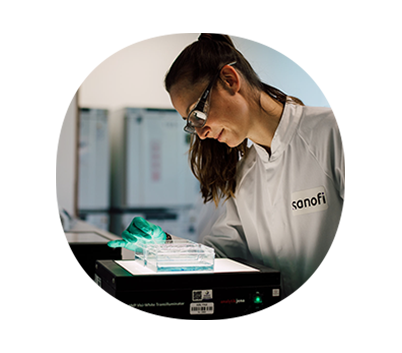
Pourquoi Sanofi ?
Accédez aux outils, à la formation et au soutien nécessaires pour atteindre vos objectifs. En réalisant votre plein potentiel, vous nous aiderez à atteindre notre objectif de réduire de moitié le temps entre la découverte et la thérapie.
-

Construisez une carrière qui a du sens
Exprimez votre passion et impactez des millions de personnes à travers le monde. Vous êtes aux commandes : fixez vos objectifs et nous vous offrirons la formation et le soutien nécessaires pour les atteindre.
Rejoignez notre communauté
de talents
Que pourrions-nous accomplir ensemble ? Chaque Sanofien travaille sur des projets qui ont un véritable impact sur la vie des gens.
Inscrivez-vous dès aujourd'hui et découvrez nos dernières opportunités dès qu'elles seront disponibles.